

How to Find Product Market Fit A Startup's Guide to Growth
Finding product-market fit is the whole game. It’s that magical point where you stop pushing your product onto the market, and the market starts pulling it from you. You're no longer fighting for every sale; instead, you're building a powerful momentum that seems to have a life of its own.
You’ll know you’ve found it when growth starts feeling organic and those long, painful sales cycles get shorter and shorter.
What Product Market Fit Actually Feels Like
Forget the textbook definitions for a second. Product-market fit (PMF) isn't some abstract concept you read about in a business book; it's a real, tangible force that can turn a struggling startup into a company that’s actually going somewhere.
It’s the difference between pushing a giant boulder uphill and watching it roll downhill, picking up speed on its own.

When you hit PMF, a few things happen almost all at once:
- Customers find you: Instead of chasing down every single user, people start showing up through word-of-mouth. Your current customers become your most effective salespeople, all without you asking.
- Your product becomes essential: People don't just sign up and forget about it. They weave your product into their daily lives and workflows. It becomes something they can't imagine working without.
- The conversation changes: You'll find yourself spending less time trying to convince people they even have a problem and more time talking about how your solution is the best way to fix it.
Why PMF Is a Matter of Survival
Achieving product-market fit is the single most important milestone for any new company. The stakes are incredibly high. Data shows that 42% of failed startups point to 'no market need' as the primary reason they went under—that’s a bigger reason than running out of cash.
They built something nobody actually wanted.
Finding product-market fit is not a one-time event, but the beginning of a new phase. It's the unlock that makes scaling possible. Before PMF, your job is to learn. After PMF, your job is to grow.
This whole process is about methodically taking the risk out of your idea. You’re not just building a cool product; you’re validating a real business. We all know that over 90% of startups fail, but here’s the interesting part: among those that make it, a massive 70% say that finding product-market fit early was the key to their survival. You can read the full research about PMF for startup success to see just how critical this is.
Busting Common Myths
A lot of founders fall into the trap of thinking PMF is a finish line you cross once and you're done. It's not. It’s a state you have to achieve and then fight to maintain. Markets change, customer needs shift, and new competitors pop up.
Think about Slack. They found incredible growth because they solved a massive, painful problem for teams that were drowning in email. That led to the kind of organic adoption most companies only dream of. But their success wasn't an accident; it was the direct result of a relentless focus on a widespread problem.
This guide will walk you through a clear, systematic framework for finding and proving your own product-market fit. We’re going to move past hunches and gut feelings and focus on a data-backed process that seriously improves your odds of building something that doesn’t just launch, but truly takes off. The alternative is becoming just another statistic—a solution looking for a problem to solve.
Defining Your Hypothesis and First Target Audience
Before you write a single line of code, the hunt for product–market fit kicks off with a sharp, testable hypothesis. It's so tempting to think your big idea is for "everyone," but that’s a classic startup mistake. Real progress comes from zeroing in on a very specific group of people who have a very specific, painful problem.
This isn't just about picking a demographic. It’s about creating a crystal-clear Ideal Customer Profile (ICP). Your ICP is the exact person who will get the most value from what you're building—and they’re already looking for a way to solve their "hair-on-fire" problem. This is a problem so urgent they'll happily pay to make it go away, not just some mild inconvenience they can live with.

Starting small is actually a huge advantage. By focusing on a niche "beachhead market"—a small, specific segment you can completely own—you build momentum. Once you’ve won over that first group, you earn the credibility (and the cash) to expand into adjacent markets. Try to be everything to everyone right out of the gate, and you'll end up being nothing to anyone.
Crafting a Testable Hypothesis
Think of your initial hypothesis as the foundation for your entire search. It’s a simple statement connecting a specific customer to their problem and your proposed solution. This isn't some vague mission statement; it's a scientific premise you’re about to either prove or disprove.
A strong hypothesis needs to clearly spell out:
- The Target: Who, exactly, are you building this for? (e.g., "Early-stage B2B SaaS founders...")
- The Problem: What's their urgent, unmet need? (...who struggle to find high-intent leads on social media...)
- The Solution: How does your product uniquely fix this? (...will use our AI-powered monitoring tool to spot qualified prospects...)
- The Outcome: What's the measurable benefit? (...resulting in a 20% increase in their sales pipeline within three months.)
This structure turns a fuzzy idea into a focused mission. Now, every decision you make—from product features to marketing copy—is designed to test this core assumption. A solid hypothesis makes it way easier to measure success and know when it's time to pivot. For a deeper dive, you can learn more about how to identify your target audience in our detailed guide.
Mapping and Prioritizing Your Assumptions
Every new venture is built on a mountain of assumptions. You assume people have a certain problem, you assume they'll pay to solve it, and you assume your solution is the best way to do it. The trick is to figure out which of these assumptions are the riskiest and test those first.
Don't fall in love with your initial idea. Fall in love with your customer's problem. Your idea is just one of many possible solutions, and it will almost certainly change as you learn more.
To de-risk your venture, start by just listing out every single assumption you're making about your customer, the market, and your product.
Example Assumptions to Test:
- Problem Assumption: Do B2B founders actually see social listening as a high-priority channel for lead gen?
- Solution Assumption: Will they prefer an automated AI tool over manually searching or hiring a social media manager?
- Pricing Assumption: Are they really willing to pay a $99 monthly subscription for this?
Got your list? Now rank them. Which assumption, if proven wrong, would completely blow up your business model? That's the one you test first. This disciplined approach stops you from wasting months building a product on a shaky foundation. Your goal isn't to be right from the start; it's to learn as quickly and cheaply as you can.
Uncovering Insights Through Customer Discovery
Once you have a solid hypothesis and a clear picture of your target audience, it’s time to leave the comfort of your office. The search for product-market fit isn't won in a conference room; it's won through direct, unfiltered conversations with the very people you want to help. This is the customer discovery phase, where your assumptions get a reality check.
Your goal here isn't to pitch your product. In fact, you shouldn't even bring it up at first. The real mission is to become an expert on your customers' world—their workflows, their frustrations, and the real problems they face. You’re on the hunt for genuine pain points, not just someone to validate your brilliant idea.
The Art of the Interview
The interview is the heart and soul of customer discovery. Think of it less like a rigid survey and more like a semi-structured conversation designed to pull out stories. The best insights bubble up when you ask open-ended questions that get people talking about their own experiences and goals.
Steer clear of questions that lead the witness, like, "Wouldn't it be great if you had a tool that did X?" That just gets you polite agreement. Instead, ask questions that uncover what people have done in the past and the challenges they're dealing with right now:
- "Can you walk me through how you currently handle [the process related to your problem]?"
- "What's the most frustrating part of that process?"
- "Have you tried to solve this problem before? What happened?"
- "If you had a magic wand, what would you change about how you do [task]?"
Questions like these get people talking about what they actually do, not what they imagine they might do. That's a critical difference. To avoid building a product nobody wants, it's essential to learn how to validate product ideas fast before you write a single line of code.
The most valuable insights come from listening, not talking. Aim for an 80/20 split where the customer does most of the talking. Your job is to guide the conversation and dig deeper when you hear something interesting.
Finding the right people to talk to is half the battle. Your immediate network is a good starting point, but you need to expand quickly into the online communities where your ideal customers actually spend their time. Check out relevant LinkedIn groups, industry forums, or specific subreddits. You’re looking for people who are actively living with the problem you aim to solve.
Crafting a Flexible Script
While you never want to read from a script word-for-word, having a flexible guide is a lifesaver. It keeps you on track and makes sure you cover the key areas you need to explore, all without killing the natural flow of the conversation.
Your interview guide should probably include:
- Warm-up Questions: Start with easy questions about their role and day-to-day work to build rapport.
- Problem Exploration: This is the core of the interview, focusing entirely on their workflows and pain points.
- Solution Exploration (Optional): Near the end, you can gently introduce your concept and see how they react.
- Wrap-up: Always thank them for their time and ask if they know anyone else who might be good to talk to.
A classic mistake is jumping to your solution too early. Resist the urge. The longer you can stay in the "problem space," the richer your insights will be. What you're listening for are patterns. After 10-15 interviews, you should start hearing the same problems and frustrations over and over again. That's a strong signal you're onto something real. For businesses trying to scale this, checking out the top customer intelligence platforms can offer a more structured way to manage and analyze all this feedback.
Beyond the Interview: Social Listening
Interviews are incredibly powerful, but they aren't your only tool. Modern customer discovery also involves "listening in" on conversations that are already happening online. This is where social listening becomes your secret weapon.
Platforms like Reddit, X (formerly Twitter), and niche industry forums are absolute goldmines of candid feedback. People aren't trying to be polite to you in an interview; they're openly complaining about their problems and asking their peers for solutions. This is raw, unfiltered customer intelligence.
Pro Tip: Use tools to monitor keywords related to your problem space. For instance, if you're building a project management tool, set up alerts for phrases like "hate Asana," "Jira alternative," or "how to manage remote team tasks." This surfaces high-intent conversations where you can both learn and engage directly with potential users. These digital breadcrumbs often lead you straight to the "hair-on-fire" problems that signal a strong market need, ultimately accelerating your path to product-market fit.
The Key Metrics That Signal Product Market Fit
Product-market fit isn’t just a gut feeling or some vague sense of momentum. You can—and absolutely should—track it with hard data. Moving from qualitative hunches to quantitative proof is how you know for sure that you're on the right path. Think of your key metrics dashboard as a compass; it tells you whether you're building something people genuinely want or just spinning your wheels.
These signals really fall into two buckets: leading indicators (the early signs you're heading in the right direction) and lagging indicators (the proof that you've actually arrived). Keeping an eye on both gives you the full picture.
The Sean Ellis Test The Gold Standard
One of the most powerful leading indicators is the Sean Ellis Test, named after the growth hacker who made it famous. It’s a dead-simple survey with one critical question you ask your most engaged users: "How would you feel if you could no longer use this product?"
The answers are pretty straightforward:
- Very disappointed
- Somewhat disappointed
- Not disappointed
Here's the magic number: if at least 40% of your users say they’d be "very disappointed," you have a strong signal of product-market fit. This isn't some arbitrary benchmark. It’s a proven threshold that separates products with passionate, loyal users from those that are just nice-to-haves.
The Sean Ellis Test has been validated across hundreds of startups. Hitting that 40% mark almost always correlates with explosive growth. Take Superhuman, for example. The email client initially scored a lackluster 22%. But by obsessively listening to that core group and refining the product just for them, they eventually soared to 58%—a jump that happened right as their waitlist blew up.
Analyzing User Retention and Engagement
Surveys give you a snapshot in time, but user behavior tells the ongoing story. This is where retention comes in, and it's arguably the most critical lagging indicator of product-market fit. If people stick around, it means your product has become an essential part of their workflow or daily routine.
The best way to see this is with a cohort retention curve. This chart groups users by when they signed up (e.g., everyone from January) and shows you what percentage of them are still active over time.
A flat or "smiling" retention curve is the holy grail. It means that after an initial drop-off, a stable core of users sticks around month after month. A curve that keeps diving toward zero is a massive red flag that you haven't found fit.
For a B2B SaaS product, you’re looking for 70-80% retention after the first month. For consumer apps, hitting 25% retention by week four is a good floor, with 40% being elite.
Key Financial and Growth Metrics
Once you've built a sticky product, the money should follow. These financial metrics are the concrete evidence that your product isn't just loved—it's the foundation of a sustainable business.
Lifetime Value (LTV) to Customer Acquisition Cost (CAC) Ratio
This ratio is the ultimate health check for your business model. It answers a simple question: Do we make more money from a customer than it costs us to get them in the first place?
- A healthy LTV to CAC ratio is generally considered to be 3:1 or higher.
- When your LTV is significantly higher than your CAC, you've proven you can acquire customers profitably. That's a hallmark of a business with strong product-market fit.
- But if your CAC is creeping up close to your LTV, your growth is unsustainable, no matter how much your users love you. A great place to start is our guide on customer acquisition cost calculation to make sure you're tracking this correctly.
Net Promoter Score (NPS)
The Net Promoter Score (NPS) is all about measuring customer loyalty. It boils down to one simple question: "On a scale of 0-10, how likely are you to recommend our product to a friend or colleague?"
Based on their scores, customers are bucketed into three groups:
- Promoters (9-10): These are your die-hard fans and advocates.
- Passives (7-8): They're satisfied but not loyal enough to spread the word.
- Detractors (0-6): These are unhappy customers who might even damage your brand.
A high NPS, typically anything above 50, suggests your customers are so happy that they're actively driving word-of-mouth growth for you. This kind of organic marketing engine is a powerful sign that the market itself is pulling your product forward.
Here’s a quick summary of the key signals to watch for on your journey to product-market fit.
Key Indicators of Product Market Fit
| Metric/Indicator | What It Measures | Strong PMF Signal |
|---|---|---|
| Sean Ellis Test | User indispensability and emotional connection to the product. | 40%+ of users would be "very disappointed" if it disappeared. |
| Retention Curve | Long-term user engagement and product stickiness. | A curve that flattens out after the initial drop-off. |
| LTV:CAC Ratio | The profitability and sustainability of your business model. | 3:1 or higher. |
| Net Promoter Score (NPS) | Customer loyalty and the potential for word-of-mouth growth. | A score of 50+. |
| Organic Growth | The market's natural pull for your product. | High percentage of signups from direct or organic channels. |
Tracking these numbers gives you a clear, data-driven narrative about where you stand. For a deeper dive into mobile-specific metrics, check out these 10 key metrics for mobile apps. Combining these quantitative signals will guide your journey and tell you exactly when you've struck gold.
Building Your MVP for Rapid Learning and Iteration
You've done the interviews, you've gathered the initial customer insights—now what? It's time to turn those conversations and scribbled notes into something tangible. But this isn't the moment to build your grand, all-the-bells-and-whistles product vision. Instead, you need to build a Minimum Viable Product (MVP).
Think of an MVP as the simplest version of your product that solves a core problem for a specific group of people. The "V" is for viable, not minimal. It has to actually work and deliver real value. The goal here isn't to make millions overnight; it's to maximize learning while minimizing the time and money you spend building. An MVP is a scientific instrument designed to test your biggest assumptions with real users.
Choosing the Right MVP for Your Stage
Not all MVPs are created equal, and rushing to code a functional prototype isn't always the smartest first move. The right approach depends on your product, your market, and, most importantly, the riskiest assumptions you need to validate.
There are a few classic ways to approach this, each built for a different kind of learning:
- Landing Page MVP: This is often the fastest and cheapest way to start. You create a single webpage that clearly explains your value proposition, maybe shows a few mockups, and has a clear call-to-action like "Sign up for early access." It’s an incredible way to gauge interest and measure if anyone even cares before a single line of code is written.
- Concierge MVP: With this method, you manually deliver the service your product will one day automate. Building an AI-powered meal planning app? Great. Start by personally creating meal plans for your first ten customers over email. This gives you deep, unfiltered insight into their real needs and workflow. It's high-touch, but the learnings are priceless.
- "Wizard of Oz" MVP: This one looks fully functional on the outside, but behind the scenes, it's all humans pulling the levers. It’s perfect for testing complex algorithms or automated processes before you spend a fortune building the tech. Your users get the full experience, and you get to validate whether there's real demand for the outcome.
The key is to ask yourself: what’s my biggest, scariest assumption? If you're worried people won't pay, a landing page with a pre-order button can test that. If you’re unsure the workflow you designed actually makes sense for users, a Concierge MVP will tell you.
Creating a Tight Feedback Loop
An MVP is pretty useless without a system for collecting and acting on feedback. Your entire mission is to create a tight, continuous loop: build, measure, learn. And you want this cycle to be as short as humanly possible so you can iterate based on real-world data, not just what you think is a good idea.
Get organized. A simple spreadsheet or a dedicated tool can help you track user comments, bug reports, and feature requests. You're looking for patterns. If five of your first twenty users are all asking for the same thing, that's a massive signal about what to build next.
This whole process is about methodically de-risking your business. Each cycle either validates or invalidates a piece of your hypothesis, steering you closer to a solution the market will actually pay for. You're making a series of small, informed bets instead of one huge, blind one.
The flow diagram below shows how you can think about the metrics you’ll be tracking.
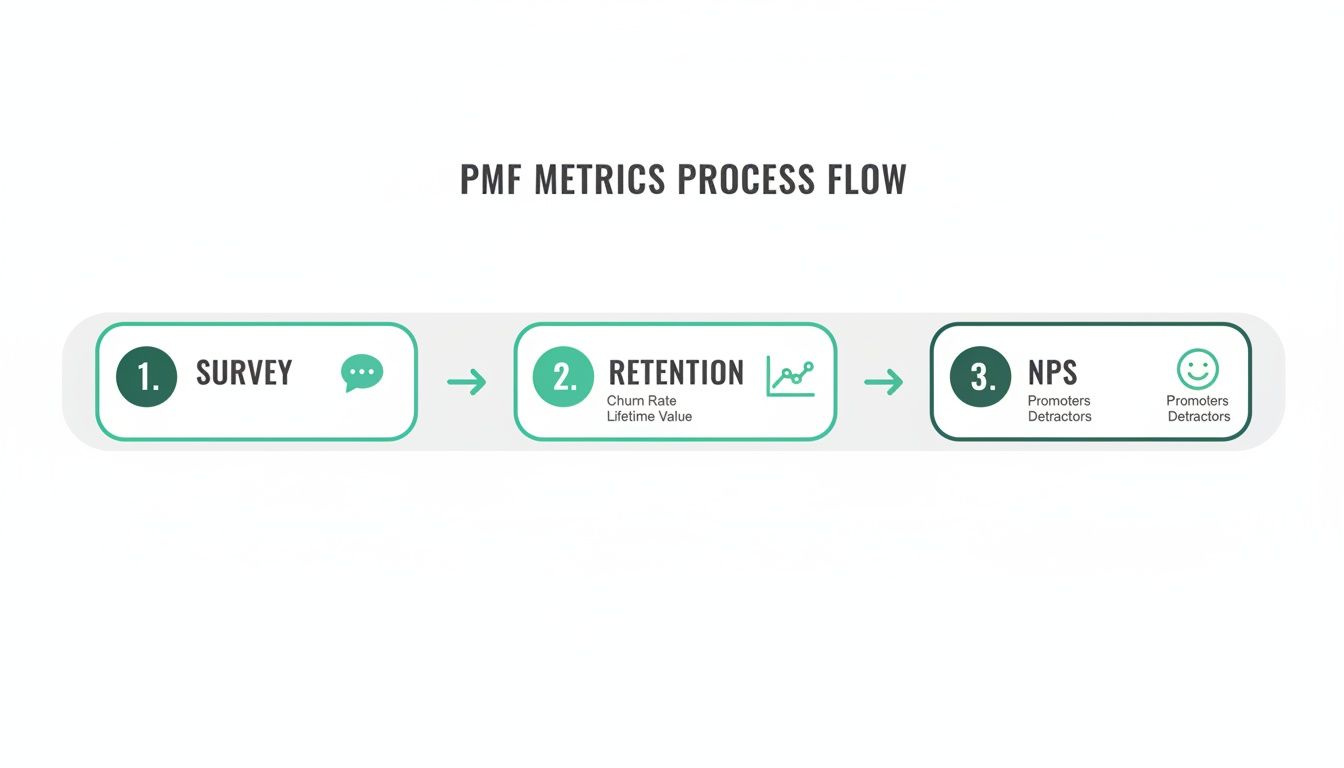
As you can see, the qualitative feedback from surveys directly informs the quantitative metrics you need to track, like retention and loyalty, giving you a complete picture of both sentiment and behavior.
The purpose of an MVP is to learn, not to earn. Every feature should be a tool for answering a critical question about your users and the market.
Ultimately, the data from your MVP feeds the core metrics that define product-market fit. To find it statistically, you have to live and breathe your cohort retention curves. For a consumer product, 25% week-4 retention is the floor, while 40% is elite. For B2B SaaS, you're looking for 70-80% month-1 retention.
Other strong signals include a high LTV:CAC ratio (ideally >3:1), solid conversion rates (>10% from trial-to-paid), and a sales cycle that's getting shorter over time. The spectacular failure of Quibi, which burned through $1.75 billion before shutting down, is a cautionary tale of what happens when these metrics are ignored. You can discover more insights about startup metrics from Stripe. This data-driven approach turns the search for product-market fit from a guessing game into a methodical process of discovery.
Common Questions About Finding Product-Market Fit
The road to product-market fit is almost never a straight line. It's filled with twists, turns, and tough questions that don't have clean, textbook answers. I've seen founders wrestle with these dilemmas time and again.
This section is for when you hit those roadblocks—think of it as a quick field guide for navigating the messy parts of the process.
How Long Does It Take to Find PMF?
There’s no magic number here. For some lucky startups, it clicks in a few months. For others, it’s a multi-year grind of relentless iteration. The timeline really depends on your product's complexity, how mature your market is, and—most importantly—how fast you can cycle through the build-measure-learn loop.
Instead of fixating on a deadline, obsess over the speed of your learning. Are you talking to customers every week? Shipping improvements constantly? Seeing your core metrics nudge in the right direction? A fast iteration cycle is infinitely more valuable than a fixed timeline.
Your goal isn't to hit product-market fit by a certain date. It's to learn faster than your competitors and before you run out of cash. Velocity of learning is the only metric that matters here.
One of the biggest traps I see is premature scaling. Founders get antsy and pour fuel on the fire before they have real evidence of fit, like a flattening retention curve or hitting that 40% benchmark on the Sean Ellis Test. Rushing this phase is one of the surest ways to burn through your runway and crash.
Can You Lose Product-Market Fit?
Absolutely. Product-market fit isn't a trophy you win and put on a shelf; it's a state of being that you have to constantly maintain. Markets are living things. Customer needs evolve, new tech pops up, and competitors are always nipping at your heels. What worked last year might be totally irrelevant next year.
Just think of the graveyard of companies that once owned their space but failed to adapt. Their initial fit eroded because they stopped listening and got complacent.
To avoid that fate, you have to be relentless about:
- Staying close to your customers: Keep those feedback channels wide open. Never stop the interviews.
- Watching the market like a hawk: Pay attention to new trends and what your competitors are shipping.
- Constant iteration: Your product is never "done." Ever.
Losing PMF is usually a slow burn. You'll see it in declining retention, growth that starts to sputter, and a customer acquisition cost that just keeps creeping up. If you stay vigilant, you can spot the signs and adapt before it's too late.
How Do You Balance Founder Vision with Market Feedback?
This is one of the toughest tightropes to walk. Your vision is what got you here, but being too rigid about it when the market is telling you something else is a recipe for failure. The trick is to hold your vision loosely but grip your understanding of the customer’s problem tightly.
Your core mission—the "why" behind what you're building—can stay firm. But the "what" and the "how"—the specific features, the UX, the go-to-market motion—should be completely flexible and shaped by what your users are telling you.
Let customer insights drive your roadmap, not your ego. When you're torn, always default to solving the most painful problem for your most passionate users. They'll show you the way.
Ready to stop guessing and find high-intent customers who are already talking about their problems online? Intently uses AI to monitor platforms like Reddit and X, surfacing qualified leads and conversations for your GTM team. Stop searching and start engaging. Discover your next customer with Intently.