

What is Conversational Marketing? A Quick Guide to Real-Time Engagement
Conversational marketing is just a fancy way of saying you’re talking with your customers, not at them. It’s about creating real-time, one-on-one dialogues using channels like chatbots and live chat.
Instead of making people fill out a form and wait for an email, you’re there to talk the second they have a question. This immediate, two-way conversation guides people through your sales funnel in a way that feels natural and helpful.
The Shift to Real-Time Dialogue
Think about the last time you walked into a store. A helpful associate probably greeted you, ready to answer questions or point you in the right direction. That simple, human interaction is exactly what conversational marketing brings to the digital space.
It completely replaces the old, frustrating experience of submitting a contact form and waiting days for a reply. It’s a fundamental change from traditional marketing, which often feels like you're just shouting into the void with ads and email blasts. By engaging in a genuine back-and-forth, you can understand what a customer needs, answer their questions instantly, and start building a real relationship from the very first click.
Why This Matters More Than Ever
Let's face it: today's buyers expect speed and a personal touch. They don't have the patience to dig through your website for information or wait for business hours to get an answer.
This demand for instant gratification is precisely what makes this approach so powerful. It meets people where they are, on their own time. And honestly, for a deep dive into why this is so critical, it’s worth understanding the core principles of great client communication best practices.
This move toward instant, helpful dialogue is a key factor in improving customer experience. By being available 24/7 to guide, assist, and qualify leads, businesses are able to dramatically shorten their sales cycles.
A conversation is a shortcut to conversion. Instead of making potential customers jump through hoops, you're offering a direct path to the answers they need, which builds trust and accelerates their decision-making process.
The explosive growth of the tools behind this strategy tells the whole story. The global chatbot market—a cornerstone of this approach—is on track to hit $15.57 billion in 2025 and is expected to skyrocket to $46.64 billion by 2029. This isn't just hype; it's driven by real adoption, with a staggering 987 million people worldwide already using AI chatbots.
Conversational marketing isn't just a fleeting trend. It’s a direct response to how customers want to be treated—with smarter, faster, and more personal interactions.
Traditional Marketing vs Conversational Marketing At A Glance
To really see the difference, it helps to put the old way and the new way side-by-side. The table below breaks down the fundamental shift from one-way broadcasting to genuine, two-way dialogue.
| Aspect | Traditional Marketing (One-Way) | Conversational Marketing (Two-Way) |
|---|---|---|
| Communication Style | Monologue (Broadcasting messages) | Dialogue (Real-time conversations) |
| Primary Goal | Generate leads for sales to follow up on | Engage, qualify, and convert leads now |
| Customer Experience | Passive, often frustrating (forms, waiting) | Interactive, immediate, and helpful |
| Availability | Restricted to business hours | Always-on, 24/7 availability |
| Sales Cycle | Long and drawn out | Shortened and accelerated |
| Tone | Formal and corporate | Personal, friendly, and human |
| Lead Flow | Leads wait for you | You engage leads on their terms |
This comparison makes it clear: one approach is about making customers wait, while the other is about meeting them exactly when and where they need you. That’s the core of why conversational marketing is so effective.
The Three Pillars of a Winning Conversational Strategy
A powerful conversational marketing approach doesn't just happen by accident. It's built on a foundation of three core principles that work together to create a seamless, effective, and human-centric customer experience. Getting these pillars right is the key to turning simple chats into a real engine for business growth.
Each pillar tackles a different part of the customer interaction, from that first "hello" to the long-term insights you gather. Together, they create a solid framework for building relationships that actually drive results.
This visual concept map breaks down the whole idea into its essential components: the tools you'll use, the goals you're aiming for, and the benefits you can expect.
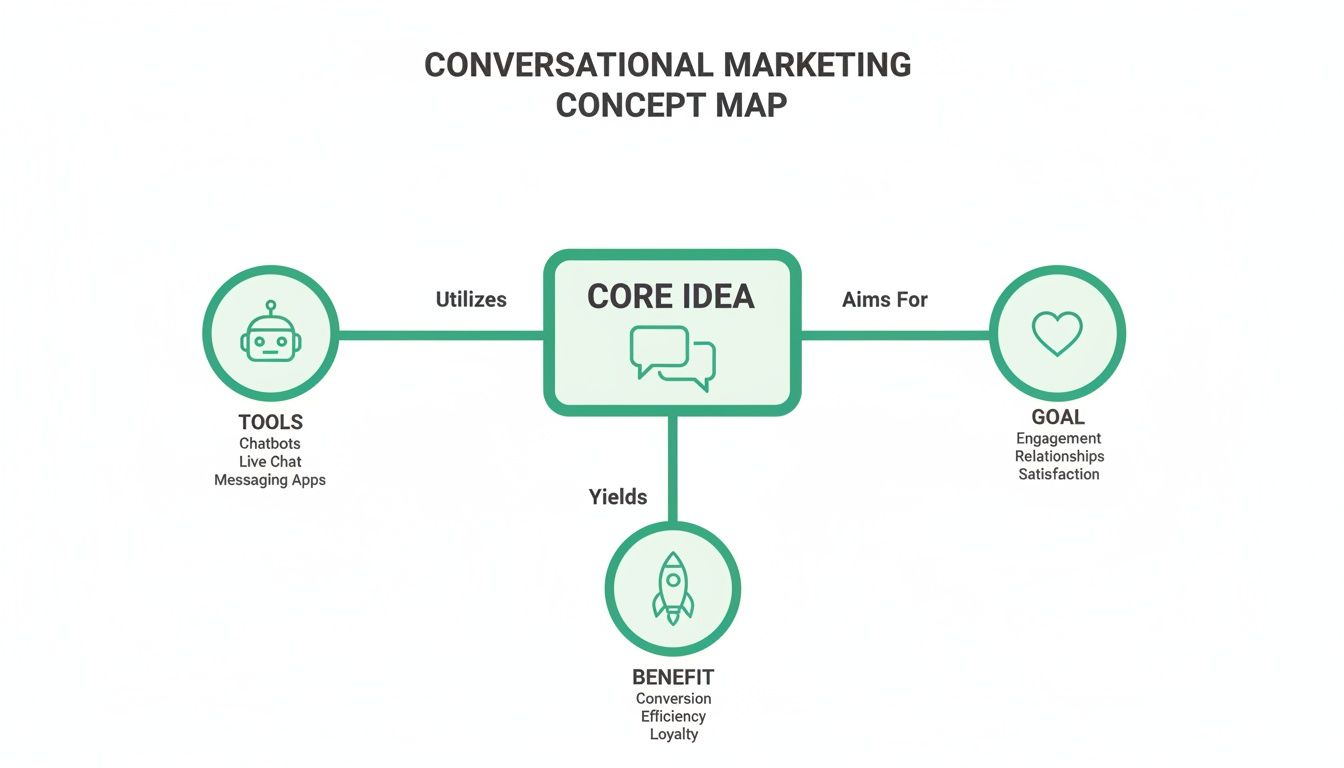
As the map shows, it's all about creating better relationships. When you do that using accessible tools like chatbots, you end up accelerating your company's growth.
Pillar One: Real-Time Engagement
The first and most crucial pillar is real-time engagement. This is all about being available the exact moment a customer or prospect needs you. Instead of making them fill out a form and wait for an email, you meet them right on your website or social media with an instant answer.
Think of it like having a helpful store associate in every aisle of your digital shop. This is often powered by tools like AI chatbots, which can handle common questions 24/7, or live chat that connects visitors with a human agent for more complex issues. The goal is to eliminate friction and provide immediate value.
Pillar Two: Personalization at Scale
Next up is personalization at scale. A great conversation feels like it’s tailored to the individual, not like a generic script. This pillar is about using data—like a visitor’s browsing history, past purchases, or location—to make every single interaction uniquely relevant.
It’s the difference between a generic "How can I help you?" and a much more specific, "Hey, I see you're looking at our enterprise software plans. Do you have any questions about the integration features?" This level of personalization makes customers feel seen, understood, and valued.
Personalization transforms a monologue into a dialogue. It shows the customer you’re not just listening, but that you actually understand their specific needs and context, which is the fastest way to build trust.
Pillar Three: Continuous Feedback Loops
The final pillar is creating continuous feedback loops. Every conversation your business has is a goldmine of customer insights. This principle is about systematically capturing, analyzing, and then acting on the feedback you get through every chat.
Are customers repeatedly asking about a specific feature? Are they getting confused about your pricing? These conversations reveal pain points and opportunities in real-time. By treating each interaction as a source of data, you can constantly refine your products, improve your marketing messages, and enhance the overall customer experience. This makes your entire business more responsive to what customers actually want.
Key Business Benefits Driving Widespread Adoption

Beyond just feeling more personal, conversational marketing delivers real, measurable results that hit the bottom line. This isn't about making tiny tweaks around the edges; it's a fundamental shift in how you operate and grow. The benefits are clear, tangible, and give you a serious competitive edge.
When you stop making customers wait and start engaging them instantly, you transform key parts of your business. Let's dig into three of the biggest benefits that have companies everywhere jumping on board.
Accelerated Sales Cycles
Traditional sales funnels are notoriously slow and full of leaks. A potential customer fills out a form, then sits around waiting for a sales rep to maybe get back to them, kicking off a long game of email tag.
Conversational marketing blows that old model up.
By using an intelligent chatbot, you can ask qualifying questions the second a visitor hits your site. This immediate back-and-forth can route high-intent leads straight to a sales rep's calendar to book a meeting on the spot. It dramatically shortens the path from "just looking" to "deal closed."
Enhanced Customer Loyalty
Loyalty isn't built on transactions; it’s built on trust and great experiences. Every time you provide a personalized, helpful, and immediate interaction, you're reinforcing the idea that you value your customer's time and actually want to help them succeed.
This is how you turn one-time buyers into repeat customers and, even better, into passionate brand advocates. The data backs this up in a big way.
Post-deployment, 82% of brands witness increased loyalty and 68% achieve higher retention, driven largely by instant responses and personalization. This demonstrates how responsive communication is a direct driver of long-term customer relationships. You can explore more compelling conversational marketing statistics to see the full impact.
Improved Operational Efficiency
Finally, this approach just makes your whole team more effective. Think about it: by automating the answers to all those common, repetitive questions, you free up your team to focus on what humans do best—solving complex problems and building high-value relationships.
Chatbots can handle a massive volume of routine inquiries without anyone needing to lift a finger. This doesn't just give customers instant answers 24/7; it also boosts your team’s productivity and morale by letting them focus on more strategic, fulfilling work. That efficiency gain makes for a much more agile and effective organization.
Choosing The Right Channel With Real World Examples
Knowing what conversational marketing is and why it works is one thing. Actually making it happen means you have to choose the right channels to meet your customers where they already are.
Your strategy’s success really hinges on picking a platform that feels natural for your audience. It all depends on whether they're browsing your website or just scrolling through their favorite app.
Website Chatbots For Instant Engagement
For many businesses, website chatbots are the first step into conversational marketing, and it’s easy to see why. Think of them as the friendly greeter in a physical store, ready to help visitors 24/7.
These bots can guide users to the right product, knock out frequently asked questions, and qualify leads in real time—all without a human needing to step in. They’re perfect for grabbing high-intent visitors the moment they show interest, keeping them on your site instead of letting them click away out of confusion.
Real-World Example: Sephora
The beauty giant Sephora uses a seriously smart chatbot on its website to give shoppers personalized product recommendations.
- The Strategy: The bot kicks off a quiz-like conversation, asking about skin type, style preferences, and the look someone is going for. It feels less like a sales pitch and more like getting advice from a beauty expert you trust.
- The Outcome: By pointing shoppers directly to products that fit their exact needs, Sephora simplifies what could be an overwhelming experience. The result? A big boost in conversion rates and average order value.
Messaging Apps For Personal Connection
Channels like WhatsApp and Facebook Messenger move the conversation into a much more personal space—your customer’s own inbox. This is where your brand can start building deeper, more lasting relationships.
Since people are already on these apps every day, your messages feel less like an interruption and more like a chat with a friend. They’re ideal for sending order updates, offering quick support, and nurturing leads over time with content that’s actually relevant to them.
Real-World Example: Domino's Pizza
Domino's has mastered using Facebook Messenger to make ordering a pizza as easy as sending a text.
- The Strategy: Customers can reorder their favorite pizza or track a delivery just by messaging the Domino's bot. It completely removes the friction of logging into a website or opening another app.
- The Outcome: This ridiculously convenient approach has driven a huge spike in repeat orders and customer loyalty. It meets customers on a platform they use constantly, weaving the brand right into their digital life.
The key is to select a channel that aligns with your audience's behavior. A website bot is great for immediate, on-site assistance, while messaging apps excel at fostering long-term relationships in a more intimate setting.
So, how do you decide which channel is the right fit? It comes down to your specific goals, who you’re trying to reach, and the resources you have. This table breaks down the key differences to help you make the call.
Choosing The Right Conversational Channel
| Channel | Best For | Key Benefit | Example Use Case |
|---|---|---|---|
| Website Chatbots | High-traffic websites, e-commerce, and B2B lead generation. | Instant engagement with on-site visitors, 24/7 support, and real-time lead qualification. | Answering FAQs, guiding users to products, or booking sales demos automatically. |
| Messaging Apps | Building long-term customer relationships and providing personalized support. | High open rates and direct access to users in a familiar, personal environment. | Sending order updates, providing post-purchase support, or nurturing leads with content. |
Ultimately, you don't have to choose just one. Many of the most effective strategies use a mix of channels. A customer might first interact with a chatbot on your site to ask a question, then get their shipping updates via WhatsApp. The goal is to create a seamless experience that feels helpful, not intrusive, no matter where the conversation happens.
How to Launch Your First Conversational Marketing Campaign
Jumping into conversational marketing doesn’t require a massive budget or a whole team of developers. Your first campaign can be surprisingly simple, as long as you have a clear plan and a laser focus on solving one specific problem for your customers.
Let's walk through a practical roadmap for getting your first campaign off the ground. Think of this as your checklist to make sure you hit all the essentials without getting bogged down in the details.
Step 1: Define Your Core Goal
Before you write a single message, you need to know exactly what you're trying to achieve. A fuzzy goal like "get more sales" won't cut it. You have to get specific because your objective will shape every other decision you make down the line.
Start by finding a key friction point in your customer's journey. Is your support team buried under the same five questions every day? Are great leads bouncing off your pricing page without booking a demo? A sharp, focused goal gives your campaign a real purpose and makes it much easier to measure success.
Common goals include:
- Generate more qualified leads by engaging visitors on high-intent pages.
- Improve support response times by automating answers to frequently asked questions.
- Increase demo bookings by making it simple for prospects to schedule a call right then and there.
Step 2: Map Your Customer Journey
With your goal set, it's time to put yourself in your customer's shoes. What path do they typically take on your website before they hit that point of friction? Mapping this out helps you pinpoint the perfect moment to pop up and start a conversation.
Think about the questions and roadblocks they face at each stage. For example, a visitor on your product features page is probably wondering how you stack up against a competitor. A well-placed chatbot can jump in to offer a comparison guide or connect them with a sales rep. This is a fantastic way to learn more about how to automate lead generation by meeting customers right where they are.
Step 3: Select the Right Platform
You don’t need a complex, enterprise-level system to get started. These days, there are dozens of user-friendly and affordable conversational marketing tools built for businesses of all sizes.
Look for a platform that’s easy to set up, plays nicely with the tools you already use (like your CRM), and fits your budget. Many offer free trials, which let you experiment and find the right fit without a big commitment. The key is to pick a tool that helps you launch fast, not one that adds a bunch of unnecessary complexity.
Step 4: Design a Natural Conversation Flow
This is where you write the script for your chatbot or live chat prompts. The golden rule? Keep it human. Ditch the corporate jargon and robotic phrases. Write like you're talking to a friend—use simple language, short sentences, and a genuinely helpful tone.
Your goal is to guide, not annoy. A great conversation flow anticipates the user's needs, offers clear choices (using buttons or suggested replies), and always provides an easy way to connect with a human if needed.
Start small. Create a simple conversation that solves for your main goal, then build on it over time as you see what’s working.
Step 5: Launch, Measure, and Optimize
Alright, it's time to go live. But your job isn't done. The real magic of conversational marketing comes from constantly tweaking and improving.
Track the key metrics tied to your goal, like the number of leads generated, meetings booked, or support tickets deflected. Read through the conversation logs to see where people get stuck or what questions you didn't see coming. Use this real-world feedback to polish your scripts, adjust your targeting, and make your next campaign even better.
Measuring Success With KPIs That Actually Matter
Rolling out a conversational marketing strategy without the right metrics is like flying blind. You need to look past the surface-level numbers and zero in on Key Performance Indicators (KPIs) that actually tie back to business growth. These are the numbers that prove your ROI and show you where to fine-tune your approach.
If you start thinking about measurement from day one, you'll see exactly how these real-time chats are moving the needle. We can break down the most important metrics into two key groups that, together, tell the full story—from the first hello to the final sale and beyond.
Engagement and Conversion Metrics
First things first: are people even talking to you? And are those conversations turning into real business? Chatbot-powered websites see a 23% boost in conversion rates, and businesses using AI sales agents have reported an average 67% jump in conversions. These aren't just vanity metrics; they show a direct line from good conversations to more revenue. You can find more stats on the link between conversational commerce and market growth by reviewing these insightful statistics.
Here are the core metrics to watch:
- Interaction Rate: What percentage of your site visitors actually engage with your chatbot or live chat? This tells you how well your prompts are working.
- Leads Generated: This tracks the raw number of new, qualified contacts you capture through conversations. It’s a direct measure of pipeline growth.
- Meetings Booked: A huge one for B2B. This counts how many demos or sales calls get scheduled right inside the chat window.
Tracking these initial interactions gives you a goldmine of data on how your audience behaves. It's the foundation for what are known as customer intelligence platforms, which help you refine and personalize every campaign you run down the road.
Customer Satisfaction and Efficiency Metrics
Finally, you need to know if all this conversational effort is making customers happier and your team more productive. After all, happy customers stick around, and an efficient team can focus on the big-ticket items.
- First Response Time: How long does it take for a customer to get that first reply? Speed is a massive driver of satisfaction.
- CSAT Scores: Customer Satisfaction scores collected right after a chat give you direct, unfiltered feedback on the quality of the interaction.
- Conversation Volume: Simply monitoring the number of chats helps with staffing and shows you how well the new tools are being adopted over time.
Common Questions About Conversational Marketing
Jumping into a new strategy always kicks up a few questions. When it comes to conversational marketing, most folks wonder if it’s too big for their business, if it'll replace their team, and how to keep it from sounding like a robot. Let's clear the air on some of the most common ones.
Is This Only for Large Businesses?
Not at all. While big companies might have complex, enterprise-level systems, there are plenty of affordable—and even free—tools out there for small businesses.
Simple chatbots and live chat plugins are easy to set up. This means any business can start talking with customers right away without a massive investment.
Will Chatbots Replace Our Human Support Teams?
The goal here is augmentation, not replacement. Think of chatbots as your team's first line of defense. They’re brilliant at handling the simple, repetitive questions that come in 24/7.
This frees up your human agents to tackle the complex, high-value problems that need a real person's empathy and deep expertise. A great conversational strategy creates a seamless handoff from bot to human whenever it’s needed.
Think of chatbots as your team's most reliable assistant—always on, instantly responsive, and great at handling the basics so your experts can shine on the tough stuff.
How Do I Make My Chatbot Sound Natural?
Crafting a bot that sounds human starts with giving it a clear personality that matches your brand. Write your scripts in a conversational tone and try to think ahead about what your customers will ask.
Most importantly, always give people a clear path to a solution or a human agent if they get stuck. The real key? Reviewing your conversation logs regularly to spot awkward phrasing and fix it.
By using Intently to monitor real customer conversations on social media, you can gather the exact phrasing your audience uses. This insight lets you build bots that sound incredibly natural because they’re speaking your customers’ language. Find high-intent leads and make your conversational scripts better by visiting https://intently.ai.