

What Is Real Time Marketing And How Does It Work?
Real-time marketing is all about jumping into the conversation as it's happening. It’s a nimble strategy that focuses on reacting to live events, trending topics, and customer chatter with messages that are timely, relevant, and perfectly in context. The whole idea is to turn those fleeting moments into real opportunities for engagement.
What Is Real Time Marketing In Simple Terms
Think of it like this: Traditional marketing is like showing up to a party with a prepared speech you hope the crowd will like. Real-time marketing (RTM), on the other hand, is like being a great conversationalist—you listen to what people are talking about and chime in with a clever, relevant comment right at the perfect moment. It’s less about meticulous planning and more about reacting with intelligence.
This on-the-fly approach moves away from long-term, pre-scheduled campaigns. Instead, it’s all about capitalizing on the "here and now" to slide your brand into the public consciousness when everyone's attention is already on a specific event or trend.
The Spark That Ignited RTM
The most legendary example of RTM unfolded during the 2013 Super Bowl. A power outage suddenly plunged the stadium into darkness for 34 minutes. In a stroke of genius, Oreo’s team tweeted an ad with a simple caption: "You can still dunk in the dark." It was brilliant, simple, and perfectly timed.
That single tweet racked up over 15,000 retweets in less than an hour, proving that brands could boost engagement by up to 200% compared to standard posts just by piggybacking on live events. You can get more details on this iconic marketing moment from Sprout Social's analysis.
Oreo's tweet became the textbook case for modern RTM. It showed the world that with the right preparation and a bit of quick thinking, brands could score massive visibility without a massive budget.
Real-time marketing is not about being first; it's about being right at the right time. The key is to blend speed with authenticity, creating a connection that feels organic, not opportunistic.
At its core, understanding real-time marketing comes down to three things:
- Immediacy: Responding in minutes or hours, not days.
- Relevance: Tying your brand to a current event or trending topic.
- Context: Making sure your message actually fits the conversation and audience mood.
Real Time Marketing Vs Traditional Marketing At A Glance
To really see the difference, it helps to put the two approaches side-by-side. Traditional marketing is a marathon; real-time marketing is a sprint.
| Aspect | Real Time Marketing (RTM) | Traditional Marketing |
|---|---|---|
| Planning | Agile, short-term, and reactive | Long-term, pre-planned, and scheduled |
| Execution | Immediate, often within minutes or hours | Follows a set calendar over weeks or months |
| Content | Spontaneous, conversational, and trend-driven | Polished, scripted, and brand-focused |
| Focus | Joining existing conversations | Starting new conversations |
| Risk | Higher, requires quick judgment and brand safety | Lower, with more time for review and approval |
| Goal | Engagement, brand relevance, and virality | Brand awareness, lead generation, and sales |
This table highlights the fundamental shift in mindset. While traditional marketing builds brand presence over time with carefully crafted campaigns, RTM aims for immediate impact by tapping into the cultural zeitgeist.
How Real Time Marketing Actually Works
Behind every viral real-time marketing moment is a well-oiled machine built for speed. It’s not about getting lucky; it's a finely tuned process that lets brands move at the speed of culture. The entire framework runs on a continuous, three-step loop: Detect, Decide, and Deploy.
Think of it like an emergency response team. First, they have to detect the emergency (the signal). Then, they must quickly decide on the best course of action. Finally, they deploy their resources to handle the situation. Real-time marketing follows this exact high-stakes pattern.
Step 1: Detect The Opportunity
The first and most critical stage is detection. Brands have to keep their ears to the ground, listening for the right signals amidst the constant digital noise. This is where technology becomes your best friend.
Modern marketing teams rely on sophisticated social listening tools to monitor conversations across platforms like X (formerly Twitter), Reddit, and LinkedIn. These platforms are like a digital radar, constantly scanning for specific triggers.
These triggers could be anything from:
- Trending Topics: Sudden spikes in conversations around a news story, a cultural event, or a viral meme.
- Brand Mentions: Any direct or indirect mention of your company, its products, or even key executives.
- Competitor Activity: A rival’s product launch, a major service outage, or a controversial statement they just made.
- Customer Pain Points: Conversations where potential customers are openly expressing a need or frustration that your product can solve.
By setting up alerts for these kinds of signals, teams can spot a potential RTM opportunity the second it appears.
Step 2: Decide With Data
Once a signal is detected, the clock starts ticking. The next step is to analyze the opportunity and decide on a course of action—or decide to sit it out. A rushed, off-brand response can do more harm than good, so this stage is all about making a smart call, fast.
This is where quick data analysis comes in. The team needs to assess a few key factors in minutes:
- Audience Sentiment: Is the conversation positive, negative, or neutral?
- Relevance: Does this topic actually align with our brand’s voice and values?
- Reach Potential: How big is this conversation, and is it still growing?
A successful real-time marketing decision isn't just about being fast; it's about being strategically relevant. The goal is to add value to the conversation, not just to interrupt it for the sake of visibility.
Based on this rapid-fire analysis, the team decides whether to engage and, if so, what the message should be.
Step 3: Deploy The Response
The final step is all about execution. With a decision made and a concept approved, the creative and social media teams jump into action to deploy the response. This requires an agile workflow, often with pre-approved templates or a streamlined chain of command to avoid getting stuck in bottlenecks.
Whether it’s a witty tweet, a clever graphic, or a targeted ad, the content is created and pushed live across the right channels. The key is to launch the response while the conversation is still peaking to get the biggest impact. For the best RTM teams, this entire cycle—from detection to deployment—can happen in under an hour.
The Role Of AI In Modern RTM Strategy
If real-time marketing is the engine, then artificial intelligence is the supercharger that takes it to a whole new level. AI has completely changed the game, shifting RTM from a practice of simply reacting to events to one that can actually predict them. Instead of just jumping on trends as they happen, AI-powered systems can now spot them bubbling up, giving marketing teams a massive head start.
Think of these smart algorithms as tireless digital scouts. They sift through millions of data points—social media posts, news articles, customer comments—in the blink of an eye. This allows them to identify emerging opportunities and flag important conversations long before a human team ever could, cutting out the manual work and delays that used to hold RTM back.
The core process of Detect, Decide, and Deploy gets a serious speed boost from AI, as you can see in the flow below.
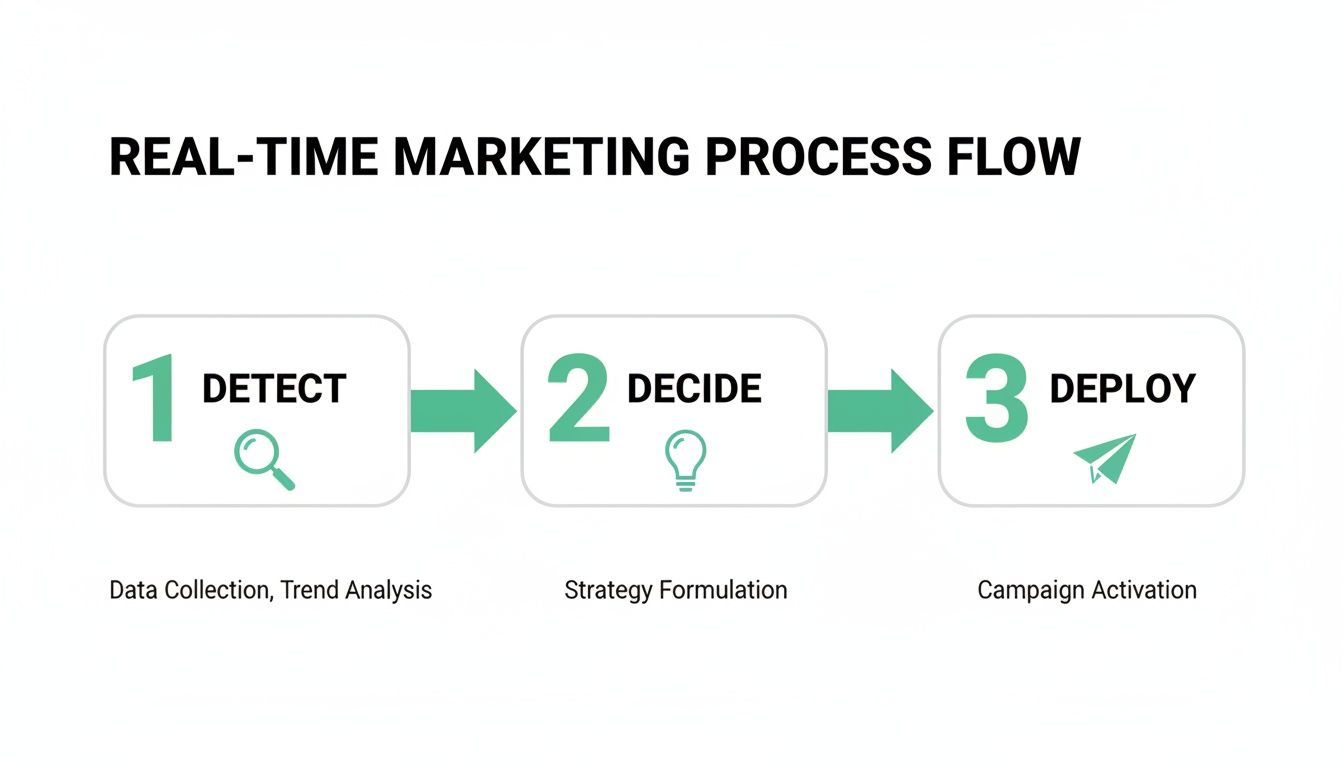
This shows just how much AI can automate and sharpen each stage, from spotting the initial signal to getting the final message out the door.
From Manual Reaction To Automated Prediction
The real magic of AI in RTM is its ability to deliver personalization on a massive scale. By 2025, the global AI marketing market is expected to hit $40 billion, a huge jump from where it was in 2022. This boom is happening because AI can slash campaign setup time by 40-60% and cut chatbot response times by another 40%, which customers absolutely love.
By digging into first-party data, AI engines can craft and send out messages that feel genuinely personal, not like they came from a robot. This frees up marketing teams to stop drowning in data and focus on what they do best: creative strategy and telling a great brand story. To get a better sense of this evolution, check out this piece on the impact of Artificial Intelligence on transforming marketing strategies.
AI doesn't replace the marketer; it elevates them. It automates the tedious and empowers the strategic, allowing creativity to flourish at the speed of conversation.
Platforms that focus on AI-powered lead generation are a perfect example of this in action. They automatically detect high-intent conversations happening on social media, letting go-to-market teams jump in with a relevant message right when a qualified lead is talking about a need. This kind of automated outreach ensures no opportunity slips through the cracks, turning fleeting online chatter into real business results.
Weighing The Pros And Cons Of RTM
Diving into real-time marketing is a bit like walking a tightrope—get it right, and the rewards are incredible, but it demands perfect balance. A well-executed RTM strategy can trigger explosive engagement, make your brand instantly relevant, and forge much stronger connections with your audience.
The ultimate prize? A viral moment. A single, perfectly timed tweet or post can generate more earned media and brand visibility than a multi-million dollar ad campaign. That’s the high-reward side of the RTM equation.
The Upside: Boosting Relevance And Building Loyalty
At its core, RTM is about connecting with your audience during the moments that actually matter to them. This immediate relevance makes your brand feel more human and in-touch, which is a massive driver for customer loyalty. Instead of just pushing a product, you're becoming part of the culture alongside your customers.
This approach brings some serious advantages to the table:
- Sharper Brand Perception: Jumping into current conversations shows your brand is agile, aware, and not stuck in the past.
- Cost-Effective Reach: Viral RTM moments can achieve massive reach organically, meaning you don't always have to lean on your paid media budget.
- Direct Audience Feedback: Real-time interactions give you instant insights into what clicks with your audience and what falls flat.
Real-time marketing flips the script, turning a brand from a broadcaster into a participant. It's the difference between giving a speech and joining a conversation, and those conversations create much more authentic and memorable connections.
The Downside: Navigating Reputational And Operational Risks
But let's be real—the speed required for RTM also opens the door to significant risks. One poorly judged response can backfire in spectacular fashion, causing serious damage to your reputation that could take months to undo. Plus, the pressure to be "always on" can put a huge operational strain on your team, leading to burnout and costly mistakes.
There are a few key pitfalls to watch out for:
- Brand Misalignment: Trying to hop on a trend that doesn't fit your brand’s voice or values can come across as desperate or, even worse, inauthentic.
- Negative Sentiment: Misreading the tone of a conversation can get your brand tied to a sensitive or controversial topic you want no part of.
- Legal Headaches: Using copyrighted material (like memes or popular images) without permission or making claims you can't back up can land you in legal hot water.
A rushed or insensitive post can quickly snowball into a full-blown crisis. That's why having a solid game plan is non-negotiable. For teams getting ready to jump in, understanding the fundamentals of social media crisis management is like having a critical safety net. This prep work helps you know when to engage and, just as importantly, when to sit back and stay silent.
To make it even clearer, let's break down the two sides of the coin.
Weighing The Pros And Cons Of Real Time Marketing
This table gives you a balanced look at the main advantages and disadvantages you'll need to consider before implementing a real-time marketing strategy.
| Benefits of RTM | Risks of RTM |
|---|---|
| Increased brand relevance by joining current conversations. | Reputational damage from a poorly judged or insensitive post. |
| Higher audience engagement and stronger customer loyalty. | Brand misalignment if the trend doesn't fit your voice or values. |
| Potential for viral reach with minimal ad spend. | Operational burnout from the pressure to be constantly "on." |
| Cost-effective marketing compared to traditional campaigns. | Legal issues from copyright infringement or unsubstantiated claims. |
| Instant feedback loop to understand your audience better. | Negative sentiment if you misread the tone of a sensitive topic. |
Ultimately, the decision to pursue RTM depends on your team's agility, your brand's personality, and your tolerance for risk. The potential rewards are huge, but they come with the responsibility of being prepared for when things don't go as planned.
How To Build Your Real Time Marketing Playbook
Alright, let's move from theory to practice. You need a solid game plan. A real-time marketing playbook is your blueprint for moving with speed and precision, making sure your team can jump on opportunities without throwing strategy out the window. This guide will walk you through building your own RTM engine from scratch.
First things first: what does a "win" look like? Your objectives have to be crystal clear. Are you trying to boost brand mentions, crank up engagement rates, or pull more website traffic from trending topics? Whatever the goal, tie it to measurable KPIs. This is how you'll track what's working and justify the resources you're putting into RTM.
Defining Your Trigger Events
You can't—and shouldn't—react to everything happening online. That's a recipe for burnout. Instead, you need to define your trigger events. These are the specific signals that tell your team it’s go-time. Think of them as your own RTM "bat signal," calling everyone to action when the right moment strikes.
Your triggers should be a mix of proactive and reactive signals. Here’s what that looks like:
- Brand Keywords: This is the low-hanging fruit—direct mentions of your company, products, or even your key executives.
- Competitor Keywords: Keep an eye on your rivals. Mentions about their service outages or unhappy customers are prime opportunities.
- Industry Trends: What key topics and hashtags are picking up steam in your niche? You need to be there.
- Customer Pain Points: Look for phrases and questions that show someone is searching for the exact solution you provide.
These triggers form the backbone of your strategy. They guide your listening efforts and make sure you only join conversations where your brand can actually add value.
Establishing A Rapid Response Workflow
Speed is the name of the game, but chaos is your worst enemy. A well-defined rapid response workflow lets your team move fast without tripping over each other. This workflow needs to map out every single step, from the moment a signal is detected to the final post-mortem after a campaign goes live.
The core of modern real-time marketing is data tracking that shrinks the gap between insight and action from days to mere seconds. By 2025, top data-driven enterprises are expected to automate up to 50% of their decisions using real-time analytics, enabling them to adjust campaigns on the fly. You can explore more insights about real-time data tracking from Reportz.io.
Your workflow must clearly state who does what. Assign roles for monitoring, content creation, legal or brand review, and final sign-off. A streamlined approval chain is non-negotiable. For low-risk opportunities, maybe you empower a small team to act on their own. For higher-stakes situations, you might need a sign-off from senior leadership. The key is deciding on these protocols before a big opportunity (or crisis) hits.
Finally, your playbook is nothing without the right tech. Investing in one of the best social listening tools is essential for catching your trigger events across platforms like X, Reddit, and LinkedIn. Tools like Intently can automate this detection, freeing up your team to focus on crafting the perfect response when it matters most. This is the infrastructure that turns your team from passive observers into active players in the conversations happening right now.
Real World Examples Of RTM Done Right
Theory is great, but seeing real-time marketing in action is where the lightbulb really goes on. Forget the famous Oreo tweet for a minute—let's break down a few clever campaigns that show how brands are nailing this strategy across different channels.
The Ongoing Roast: Wendy's on X
One of the most consistent masters of RTM is Wendy's. The fast-food chain has practically built its brand persona around witty, sarcastic, and often brutal roasts on X (formerly Twitter). The trigger isn't some big global event; it's any mention from a competitor or a fan who's brave enough to step into the ring.
Their response is always immediate, perfectly on-brand, and incredibly shareable. This isn't a one-off campaign; it's an ongoing RTM strategy that has turned their social media account into its own entertainment channel. It gives them a unique voice that cuts through the noise of their competition.
Spotify Wrapped: The Personal RTM Event
Spotify’s annual “Wrapped” campaign is a brilliant example of RTM on a massive, personalized scale. The trigger here is the end of the year—a universal moment of reflection for almost everyone. But instead of pushing out a generic "Happy Holidays" message, Spotify digs into its customer data to create a deeply personal and shareable experience for every single user.
The campaign turns millions of individual data points into a global cultural event. By making the experience highly visual and dead simple to share on social media, Spotify sparks a worldwide conversation where its users willingly become brand ambassadors. This is RTM that feels both massive and incredibly individual at the same time.
The best real-time marketing doesn't just react to the culture; it creates a cultural moment of its own. It taps into a shared experience and makes the customer the hero of the story.
Another powerful RTM tactic happens right on your own turf, reacting to customer behavior on your platform. For a fantastic look at this in action, check out these powerful abandoned cart email examples. They respond instantly to a specific user action—or, in this case, inaction.
These automated emails are triggered in real time to recover what would otherwise be a lost sale, proving just how directly RTM can impact your bottom line.
Common Questions About Real-Time Marketing
As teams start to think about weaving this kind of agile strategy into their workflow, a few questions always pop up. Getting clear on these points is the key to moving forward with confidence. Here are some of the most common things people ask when getting started with real-time marketing.
Real-Time vs. Reactive Marketing
Even though they sound almost the same, there’s an important difference between them.
Reactive marketing is usually about responding to a direct customer comment, like a complaint on social media or a question sent to your support team. It's a one-on-one conversation, mostly centered on customer service.
Real-time marketing, on the other hand, plays on a bigger stage. It’s about jumping into much larger, public conversations—think cultural moments, trending topics, or breaking news—to connect with a much wider audience. While it is a type of reaction, the goal is brand visibility and staying relevant, not just solving a single customer's problem.
How Can Small Businesses Actually Do This?
You don’t need a massive budget to pull off great real-time marketing. In fact, small businesses can be incredibly effective by being smart and focused.
- Go Hyper-Niche: Forget trying to catch huge global trends. Instead, keep an eye on the conversations happening right inside your industry or even your local community.
- Use Affordable Tools: Plenty of powerful social listening and scheduling tools have free or low-cost plans that are perfect for smaller teams.
- Lean Into Your Agility: Small teams can move way faster than big corporations that are stuck in layers of approvals. Use that speed to your advantage.
The most powerful asset in real-time marketing isn't a huge budget; it's creativity and speed. A clever, perfectly timed response will beat a pricey ad campaign any day of the week.
What KPIs Actually Measure Success?
Measuring the results of real-time marketing means looking beyond just sales numbers. The best key performance indicators (KPIs) are all about engagement and what people are saying about your brand.
- Engagement Rate: This is your most direct feedback. Likes, shares, comments, and replies show you exactly how well your content is landing with people.
- Brand Mentions: Track how many people are talking about your brand—and what they're saying—before and after you jump into a conversation.
- Website Referral Traffic: Keep an eye on how many people click through from your real-time content back to your website.
What Kind of Team Do You Need?
A solid real-time marketing team is built for two things: speed and collaboration. You need a small, empowered group where everyone knows their role. This usually includes a social media manager, a content creator (like a writer or designer), and a decision-maker who has the authority to give a quick "yes" or "no." This setup gets rid of bottlenecks and makes sure you can act the second an opportunity shows up.
Ready to stop missing out on high-intent conversations? Intently uses AI to detect qualified leads and brand opportunities across social media in real time, so your team can engage at the perfect moment. Discover your next customer at https://intently.ai.