

How to Track Brand Mentions Online and Fuel Your Growth
To really keep a pulse on what people are saying about your brand, you need a smart system. It's a mix of using the right automated tools and doing some good old-fashioned manual checks across social media, forums, and the wider web. This means using specialized software to listen for keywords and setting up real-time alerts so you can jump into conversations as they happen, helping you manage your reputation and connect with your audience before the moment passes.
Why Tracking Brand Mentions Is Your Secret Weapon for Growth
Conversations about your brand are happening all the time, whether you're in the room or not. Tuning out this digital chatter isn’t just a missed opportunity—it’s a massive strategic blind spot. What used to be a passive task has turned into a critical intelligence-gathering mission that can fuel growth, protect your reputation, and uncover honest-to-goodness customer insights you won't find anywhere else.
The market reflects this shift. The global brand mention software space is exploding and is expected to hit $923.9 million by 2025, all because the volume of online conversations has skyrocketed. This isn't just a trend; it's proof that managing your online reputation is no longer optional.
From Defense to Offense
At its heart, tracking brand mentions is a core part of a bigger strategy, often called What Is Social Media Monitoring. But it's so much more than just damage control. When you do it right, your monitoring strategy transforms raw data from public chatter into a powerful engine for business development.
Just think about the tangible results:
- Spotting a crisis early: You could catch a negative discussion on a niche forum or a Reddit thread before it blows up into a full-blown PR nightmare.
- Getting authentic customer feedback: You'll find unfiltered opinions that can directly shape your next product update or feature launch.
- Generating real leads: You can identify potential customers asking for recommendations or venting their frustrations with a competitor's product.
- Uncovering content and SEO gold: You might discover unlinked mentions that can be easily converted into valuable backlinks, giving your search authority a nice boost.
The real goal here is to switch from a reactive mindset—where you only jump in when something’s wrong—to a proactive one, where you’re actively seeking out conversations that can push your brand forward.
A Real-World Scenario
Imagine a small software startup just launched a new project management tool. By setting up simple alerts for their product's name, they stumble upon a glowing review from an industry influencer on LinkedIn. The key part? They weren't tagged, meaning they would have completely missed it otherwise.
Instead of letting that moment fade, their team engaged immediately. They thanked the influencer, shared the post on their own channels, and even put a small ad budget behind it to amplify the message. That one simple action led to a major spike in trial sign-ups and sales. It’s a perfect illustration of how tracking brand mentions online can be turned into measurable growth. This whole process is a huge piece of maintaining positive sentiment, which you can read more about in our guide to brand health tracking.
Building Your Brand Monitoring Command Center
To really get a handle on what people are saying about you online, you have to think beyond just plugging your company name into a search bar. It’s more like building an intelligence network. The whole point is to create a system that catches every important conversation while filtering out all the noise, delivering pure, actionable insights right to your team. This isn't about just listening; it's about actively setting up a system that gives you a real-time pulse on your brand's presence across the web.
The foundation of this command center is a set of smart, well-defined search queries. A simple search for your brand name is a decent start, but it’s only scratching the surface. The most valuable mentions are often indirect, tucked away inside broader conversations you might otherwise miss.
Crafting Your Search Queries
To capture the full spectrum of mentions, your queries have to be comprehensive. Start by brainstorming every possible way people might refer to you, your products, and your key people.
Get a list together that includes:
- Company Name Variations: Don’t forget common misspellings, abbreviations, or even your old company name if you recently went through a rebrand.
- Product and Service Names: Track every single product or service you offer. Include any shorthand or nicknames your customers use.
- Key Personnel: It’s a good idea to monitor mentions of your CEO, founder, or other public-facing executives. Their personal brand is directly tied to your company’s reputation.
- Campaign Hashtags and Slogans: For every marketing campaign, create a specific query to measure its reach and how people are reacting to it.
Once you have your list of keywords, the real magic happens when you use Boolean operators to sharpen your results. These simple commands—like AND, OR, and NOT—are your best friends for cutting through irrelevant chatter.
For instance, a query like ("IntentlyAI" OR "Intently.ai") AND ("review" OR "feedback") NOT "jobs" is way more effective than just searching for "IntentlyAI." It specifically hunts for conversations about reviews or feedback while kicking out job postings, which are usually just noise in this context.
Getting your query components right is the difference between a flood of irrelevant alerts and a clean, actionable feed.
Table: Essential Query Components for Comprehensive Brand Tracking
| Query Component | Example | Purpose |
|---|---|---|
| Brand Name & Variations | ("IntentlyAI" OR "Intently.ai") |
Catches your official name plus common alternatives or misspellings. |
| Product Names | ("GTM Agents" OR "Intently Agents") |
Tracks conversations around specific offerings. |
| Intent Keywords | ("review" OR "feedback" OR "alternative to") |
Finds mentions where users are evaluating or comparing solutions. |
| Negative Keywords | NOT ("jobs" OR "hiring") |
Filters out irrelevant noise like career pages or job listings. |
| Key People | ("John Doe" AND "CEO") |
Monitors the online presence and reputation of public-facing executives. |
| Campaign Terms | (#AIforSales OR "AI Lead Gen Guide") |
Measures the buzz and reception around specific marketing initiatives. |
By combining these elements, you build a monitoring net that is both wide and precise, ensuring you see the conversations that truly matter to your business.
Choosing Your Channels and Tools
With your queries locked and loaded, the next step is to put them to work across the right channels. You can definitely start with free tools like Google Alerts for basic web monitoring, but to get the complete picture, a dedicated platform is a must. These tools pull in mentions from millions of sources—social media, forums like Reddit, news sites, and blogs—and organize them in one dashboard.
If you’re trying to figure out which tool is right for you, this detailed social media listening tools comparison can help you weigh your options based on your budget and what you need to accomplish.
The ultimate goal is to create a single source of truth for your brand's online presence. A unified dashboard prevents valuable mentions from slipping through the cracks and saves your team countless hours of manual searching.
The whole process of building your brand's influence online follows a clear, cyclical path.
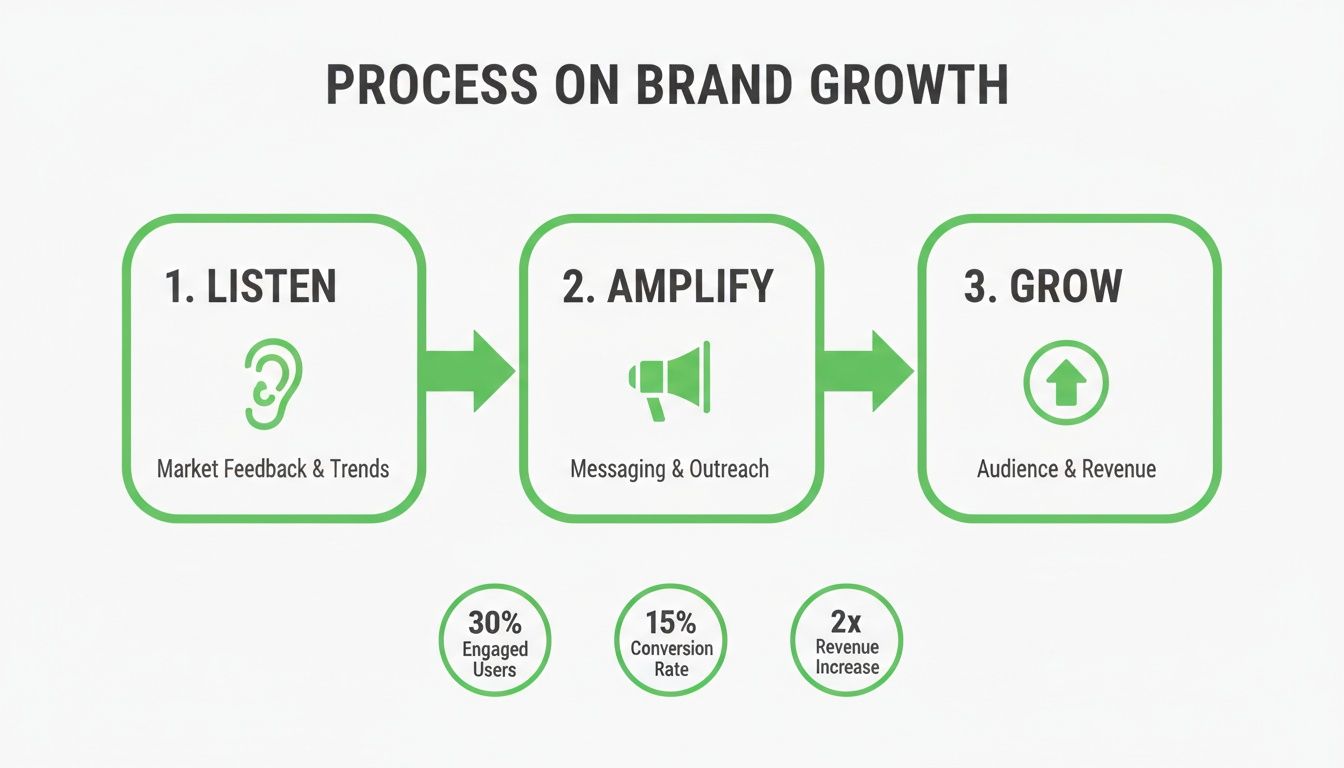
As you can see, real growth starts with listening. What you hear informs how you amplify your message and engage with your audience, which is what ultimately leads to sustained brand growth. By methodically building your command center, you're not just tracking mentions; you're creating a powerful engine for understanding your audience and moving your business forward.
Setting Up Smart Alerts to Avoid Information Overload

A constant flood of brand mentions is basically useless if it just creates more digital noise. You have to turn that raw data into actual intelligence. The way to do that is by setting up smart alerts that can tell the difference between routine chatter and a conversation you absolutely need to see.
Without this kind of filtering, your team will hit "alert fatigue" in no time. It’s that feeling when important notifications get completely buried in a sea of low-priority pings, and soon enough, people start ignoring everything.
This means you’ve got to ditch the one-size-fits-all notification strategy. What you really need is a tiered system that sends alerts to the right channel based on how urgent they are. It’s the only way to track brand mentions online effectively without driving everyone crazy.
Differentiating Between Urgency Levels
First things first: you have to sort mentions into priority levels. Not every mention needs an immediate, all-hands-on-deck response. By setting up some simple rules, you can make sure the truly critical stuff gets seen instantly, while the less urgent updates get bundled up for later.
A simple but really effective system might look something like this:
- High-Priority (Instant Alerts): These are the time-sensitive events that could seriously impact your brand's reputation or bottom line. They should trigger a real-time notification to a channel like Slack or a specific email alias.
- Medium-Priority (Daily Digest): This bucket is for important but not urgent mentions. Think positive feedback from a regular user or an unlinked mention on a mid-tier blog. Rolling these into a single daily email digest keeps the team in the loop without constant interruptions.
- Low-Priority (Weekly Report): This category is for all the general brand chatter and keyword mentions that don’t require direct engagement. This stuff is best reviewed in a weekly report to spot trends.
When you segment alerts this way, your team can focus their energy where it actually counts. An instant notification suddenly becomes a real signal for immediate action, not just another message to ignore.
Crafting a Crisis Alert Scenario
Let’s walk through a real-world example. Imagine you need a "crisis alert" to instantly flag any potential reputational threats for your leadership team. The goal is to catch a negative story before it blows up.
You can set up your monitoring tool with a very specific set of rules just for this.
Crisis Alert Configuration Example:
Here’s how you’d build it:
- Trigger Keywords: The alert fires only if your brand name shows up next to sensitive terms like
"data breach","security flaw","recall","lawsuit", or"outage". - Source Authority Filter: To weed out minor grumbles, the rule only triggers if the mention comes from a source with a high authority score or an audience of over 1 million users.
- Sentiment Analysis: The tool’s AI has to score the mention with a strongly negative sentiment. No maybes.
- Notification Channel: The moment it's triggered, an alert goes straight to a private
#crisis-commsSlack channel and an email hits the leadership team’s distribution list.
An alert this specific is a high-signal event. When it comes through, everyone knows it’s serious and needs immediate attention. This keeps you on the ball without burning out your team on a hundred false alarms a week.
How to Analyze Mentions and Find Meaning in the Noise
Getting a steady stream of mentions is a great start, but the real magic happens when you start interpreting them. Your goal is to move beyond a simple tally and uncover the stories hidden in the data. This means digging deeper than basic sentiment analysis to get to the why behind every conversation.
Automated tools are fantastic for a first pass, assigning those quick positive, negative, or neutral labels. But they often miss the nuance of human communication. Sarcasm, irony, and complex context can easily slip through the cracks, leading you to misinterpret how someone truly feels.
A comment like, "Great, another software update that changed everything," might get flagged as neutral when it’s absolutely dripping with frustration.
From Sentiment to User Intent
To really understand what’s going on, you need to start categorizing mentions by user intent. Is this a frustrated customer who needs support right now? Is it a potential lead asking buying questions about your product versus a competitor's? Or is it an enthusiastic fan who just gave you a brilliant idea for a new feature?
By systematically tagging and sorting these conversations, you build a much clearer picture of what your audience actually needs. This process transforms a chaotic feed of mentions into an organized, actionable database. To do this right, it's essential to apply robust content analysis methods that let you systematically break down the communication and pull out objective insights.
This organized approach means you can get conversations to the right people instantly.
- Support Issues: Mentions tagged with frustration or technical trouble can be automatically funneled into your service desk software.
- Sales Inquiries: Conversations with buying signals, like "Does this integrate with Salesforce?", should go straight to your sales team's CRM.
- Product Feedback: Feature requests and fresh ideas can be sent to a dedicated product management board for review.
This systematic analysis isn't just about tidying up; it's about prioritizing your response. It ensures the most critical conversations get the immediate attention they deserve, turning your monitoring efforts into a proactive engagement engine.
The impact of these conversations on how people see your brand is immense. Brand value worldwide has soared, with the top 5,000 global brands jumping from $11 trillion to over $13 trillion—a 20% increase largely fueled by what's being said online. With stats showing that in places like Japan, 94% of consumers put brand reputation first, the stakes for getting this right are incredibly high.
Ultimately, a deep dive into mention analysis helps you see the bigger picture, a topic we cover in our comprehensive social listening report. This helps you spot trends, measure how your campaigns are doing, and keep a constant finger on the pulse of your market.
Turning Conversations into Conversions and Opportunities
Alright, you’ve got a steady stream of mentions flowing in. That’s great, but just collecting them is only half the job. The real magic happens when you turn those casual conversations into something tangible for your business.
This is where your monitoring system stops being a defensive shield and becomes a proactive engine for growth. Every single mention—good, bad, or neutral—is an opportunity just waiting for you. When you track brand mentions online, you’re not just listening; you’re building a pipeline for sales, marketing, and customer support.
The trick is to have clear, repeatable playbooks ready to go. This way, your team can jump on these moments quickly and consistently, squeezing every bit of value out of each interaction.
Responding to Positive Feedback and Brand Advocates
When someone says something genuinely great about your brand, it's a gift. Seriously. Don't just hit "like" and scroll on. This is your chance to forge a real connection and turn a happy customer into someone who shouts about you from the rooftops.
Your game plan for positive mentions should be simple but powerful:
- Engage Like a Human: Get back to them quickly and personally. A simple, "Thanks so much, Sarah! We're thrilled you're enjoying the new feature," feels a world away from a canned corporate response.
- Ask for a Testimonial: If the praise is especially good, shoot your shot. Ask if you can feature their comment on your website or social media. A quick message like, "This is amazing feedback! Would you be open to us sharing this as a testimonial?" works more often than you'd think.
- Spot Your Future Advocates: Is this the third time they’ve said something nice? Flag them. Add them to a list in your CRM of potential brand champions you can tap for beta tests or invite to an exclusive community down the line.
By treating positive feedback as the start of a relationship rather than the end of a transaction, you build a loyal community that actively promotes your brand for you.
Handling Negative Comments and Customer Issues
Let’s be real—negative feedback stings. But it's also one of your best sources for improvement and a golden opportunity to show off just how good your customer service is. Handle a complaint well, and you can turn a detractor into a lifelong fan.
The main goal here is to de-escalate the situation publicly and then solve it privately.
- Acknowledge and Empathize: Your first public reply should never be defensive. Ever. Start with something like, "Hi Mike, I'm really sorry to hear you're running into this issue. That definitely sounds frustrating."
- Take It Offline: Immediately give them a way to connect with you privately. "I'd like to get this sorted out for you right away. Could you please send us a DM or email at support@yourbrand.com with your account details?"
- Close the Loop: Once you've fixed the issue behind the scenes, consider going back to the original public comment. A simple update like, "Just wanted to share that we've connected with Mike and have resolved the issue. Thanks for bringing this to our attention!" shows everyone else that you take care of your customers.
Capitalizing on Unlinked Mentions for SEO
This is one of the most powerful, yet most overlooked, perks of brand monitoring: finding unlinked brand mentions. These are goldmines. You'll find blogs or news sites that have written about your company but—for whatever reason—didn't include a link back to your website.
Every single one is a prime opportunity for a high-quality backlink.
All it takes is a friendly email. Thank them for the mention, and then politely ask if they’d be willing to add a link. This incredibly simple tactic, done consistently, can give your site’s authority a serious boost over time.
Common Questions About Tracking Brand Mentions
Whenever I talk to people about setting up brand monitoring, a few of the same questions always seem to pop up. Let's clear the air on those so you can move forward with a solid plan.
A common point of confusion is the difference between tracking brand mentions and social listening. I like to think of it this way: tracking is the what—it’s the raw data collection, the act of finding every single time someone names your brand online. Social listening is the so what—it’s the strategic part where you analyze all that data to figure out what it actually means for your business.
Tracking tells you someone mentioned you. Listening tells you why they mentioned you, how they feel about it, and what you should do next.
Can I Track Mentions for Free
You absolutely can. Getting started doesn't have to cost a dime. You can set up Google Alerts for web mentions and just use the native search functions on platforms like X and Reddit. This is a great way to dip your toes in the water and get a feel for the conversation.
But, and it's a big but, the free route is very manual and time-consuming. You'll miss a lot, and you get zero of the sophisticated analytics that paid tools offer. If you're serious about this, investing in a dedicated platform is almost always the right move.
The real value isn't just in finding mentions, but in understanding their impact. Dedicated tools automate this process, saving you time and providing deeper, more actionable insights that free methods simply can't offer.
How Often Should I Check for Mentions
This really comes down to how much online chatter your brand gets. For most businesses, a quick daily check-in is a good baseline. It’s enough to stay on top of the normal, day-to-day conversations without getting overwhelmed.
The real key, though, is to pair that daily routine with real-time alerts for the important stuff. You need to know immediately when a mention with strong negative sentiment pops up or when an influential account starts talking about you. This hybrid approach lets you handle urgent issues right away while managing the everyday chatter efficiently.
Ready to stop missing high-intent conversations and start turning mentions into revenue? Intently uses AI to find qualified leads for your business on Reddit, X, and LinkedIn. Start your free trial today.