
What Is Social Listening and what is social listening for modern brands
So, what exactly is social listening? Think of it less like simple hearing and more like active listening. It’s the art of tuning into the why behind online conversations, not just keeping a tally of the what. It's a proactive way to analyze the full context of social chatter to spot trends, gauge sentiment, and truly understand what makes your customers tick.
What Is Social Listening Explained

Imagine you own a bustling coffee shop. You hear the baristas calling out orders all day, and you overhear snippets of customer chatter. That’s social monitoring—just collecting data points.
Now, imagine you pull up a chair and sit down with those customers. You ask them why they’re raving about the new cold brew or what really frustrates them about the morning rush. That’s social listening.
This approach goes way beyond just counting mentions. It’s about interpreting the mood, opinions, and real intent behind every post and comment. When you analyze these conversations, you get actionable intelligence that can drive smarter strategies across your entire business.
The Strategic Value of Listening
The real goal isn't to rack up a high score of brand mentions. It’s about seeing the bigger picture and using that insight to make smart, proactive moves. A huge part of this involves digging deep into public perception, often through sophisticated customer sentiment analysis.
This deeper level of understanding is where the strategic gold lies:
- Product Development: You can tap into a stream of unfiltered feedback and feature requests straight from your users. This highlights unmet needs and points you toward your next big innovation.
- Marketing Strategy: Spot emerging trends and cultural shifts as they happen. This helps you build campaigns that genuinely connect with your audience instead of falling flat.
- Customer Service: Get ahead of potential problems before they blow up into public complaints. You can turn a brewing negative experience into a chance to build some serious loyalty.
Instead of just reacting to what’s already happened, social listening lets you anticipate what's coming next. It turns all that raw online chatter into a predictable roadmap for growth, helping you see where your industry is headed and how you can lead the charge.
Ultimately, social listening closes the gap between what people say and what they truly mean. It gives your teams the context they need to build better products, write stronger marketing copy, and deliver service that makes customers feel genuinely heard.
Social Listening vs Social Monitoring
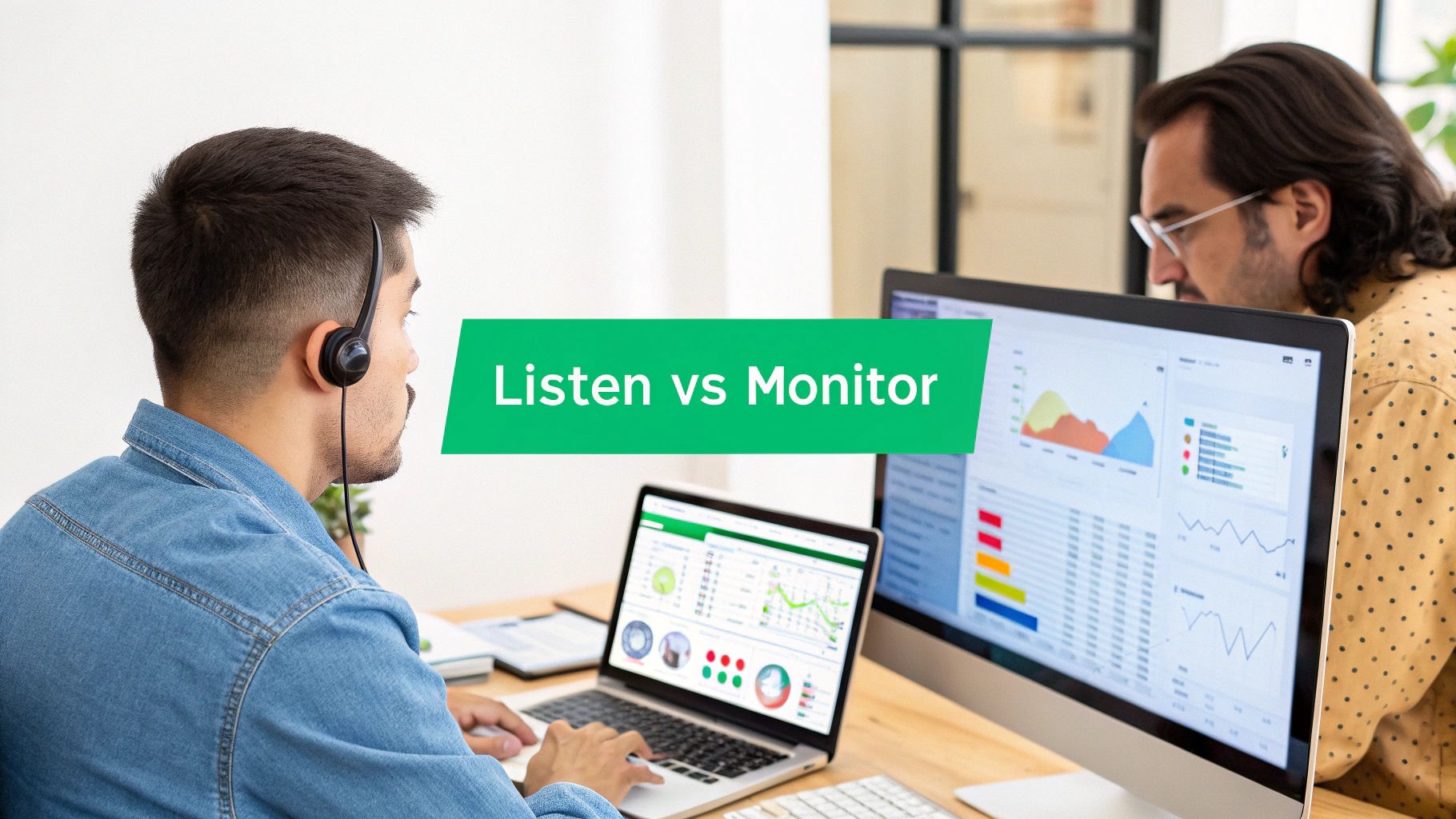
It’s easy to mix up social listening and social monitoring. After all, they both involve paying attention to what’s happening on social media. But getting the difference is what separates a basic social media strategy from one that actually drives business decisions.
Think of it like this: monitoring is reactive, while listening is proactive. They’re related, sure, but they serve completely different purposes.
Social monitoring is all about collecting data—the day-to-day work of tracking brand mentions, specific hashtags, and keywords as they pop up. It's essential for quick reactions, like jumping on a customer complaint or thanking someone for a shoutout. It answers the simple but important question, "What did people say?"
Social listening, on the other hand, takes all that data and starts asking the bigger questions. It zooms out to look at the context, the sentiment, and the real motivations behind those conversations. Instead of just gathering mentions, it helps you figure out, "Why did they say it, and what should we do about it?"
Key Differences at a Glance
Let’s use an analogy. Social monitoring is like counting raindrops as they fall. It gives you a real-time measurement of what’s happening right now. It's factual and immediate.
Social listening is like being a meteorologist. You’re not just counting raindrops; you're analyzing atmospheric pressure, wind patterns, and humidity to predict the coming storm. One is a collection of data points; the other is the strategic analysis that tells you whether to grab an umbrella or head for shelter.
If you want to dig deeper into the "raindrop counting" part of the equation, our guide on what is social media monitoring breaks down how the data collection works.
For a clearer picture, this table lays out the core differences.
Social Listening vs Social Monitoring at a Glance
Here’s a simple breakdown of how these two disciplines stack up and what they mean for your business.
| Aspect | Social Monitoring (The 'What') | Social Listening (The 'Why' & 'What Next') |
|---|---|---|
| Goal | React to individual mentions and engage with customers in the moment. | Analyze trends and sentiment to inform long-term business strategy. |
| Scope | Narrow and specific, focusing on direct mentions, hashtags, and predefined keywords. | Broad and holistic, analyzing entire conversations about your brand, competitors, and industry. |
| Timeframe | Real-time and short-term. It focuses on the immediate present and the recent past. | Long-term and forward-looking. It analyzes past data to predict future trends and opportunities. |
| Business Outcome | Improved customer service, quick crisis response, and community management. | Enhanced product development, smarter marketing campaigns, and proactive brand strategy. |
Seeing them side-by-side makes it clear: monitoring helps you manage your day-to-day online presence, while listening gives you the power to shape your company’s future.
In essence, monitoring helps you manage your day-to-day online presence. Listening empowers you to shape your future by turning raw social data into actionable business intelligence. It’s the difference between hearing the noise and understanding the conversation.
When you shift from a reactive monitoring mindset to a proactive listening strategy, you’re no longer just putting out fires. You're turning your social media presence from a simple customer service channel into a powerful engine for growth and innovation.
Unlock Growth with Social Listening
Think of social listening as more than just a marketing task—it's a powerful intelligence engine for your entire business. It’s about connecting the dots between all that online chatter and tangible growth, turning what people are saying into a proactive strategy. When every team gets access to these insights, the whole company moves smarter and faster.
For your product team, this is like having a direct, unfiltered line to your customers. They can pinpoint unmet needs and nagging frustrations that spark the next big feature. No more guessing games about what users really want; social listening lays out their pain points in their own words.
Your sales team can also treat it like a goldmine for high-intent leads. By tuning into conversations where potential customers are complaining about a competitor, they stumble upon warm leads who are actively looking for a better way to do things.
Driving Revenue and Innovation
This isn't just about passively collecting feedback. It's about turning those little nuggets of insight into action that hits the bottom line. Imagine a tech company that uses social listening to find a widespread frustration with a competitor’s confusing user interface.
This single insight can kick off a coordinated response across the company:
- Product: They fast-track updates to their own software, focusing on making their interface more intuitive and user-friendly.
- Marketing: They launch a targeted campaign that hits that exact pain point, showing off how much easier their solution is to use.
- Sales: They arm their team with scripts and battle cards that highlight the competitor's known weakness, helping them close more deals.
This entire effort, all sparked by a simple listening strategy, directly fuels innovation and boosts revenue. And it's not a niche strategy anymore. Reports show that about 62% of marketers are now actively using social listening, making it a major strategic priority. Plus, AI-powered listening has been shown to lift campaign ROI by as much as 25% by sharpening targeting and content. You can discover more insights about how AI is transforming social listening tools on Pluggo.ai.
A Unified View of the Market
When you centralize all these insights, every team gets a much clearer picture of the market. The product team knows what to build, marketing knows how to position it, and sales knows exactly who to talk to. This kind of alignment breaks down silos and makes sure everyone is working from the same playbook.
Social listening breaks down departmental walls by providing a single source of truth about your customers, competitors, and industry. It’s the connective tissue that aligns product innovation with market demand and sales strategy.
Ultimately, this approach helps your business get ahead of market shifts instead of just reacting to them. You stop just responding to customer service tickets and start spotting trends before they peak, identifying competitive weaknesses before they become common knowledge, and finding growth opportunities that everyone else is missing.
Putting Social Listening Into Action
Theory is one thing, but getting real results from social listening means having a clear plan. It’s time to stop talking about concepts and start executing with practical workflows that deliver actual value. Let's dig into how different teams can use social listening to hit specific business goals.
This isn't about collecting data for the sake of it. The goal is to set up targeted searches that answer your most pressing questions and trigger immediate, smart actions. By creating specific workflows, you turn the overwhelming noise of online chatter into a predictable stream of growth opportunities.
The diagram below shows how these insights create a powerful feedback loop, flowing from product innovation to sales and marketing, ultimately driving the entire business forward.
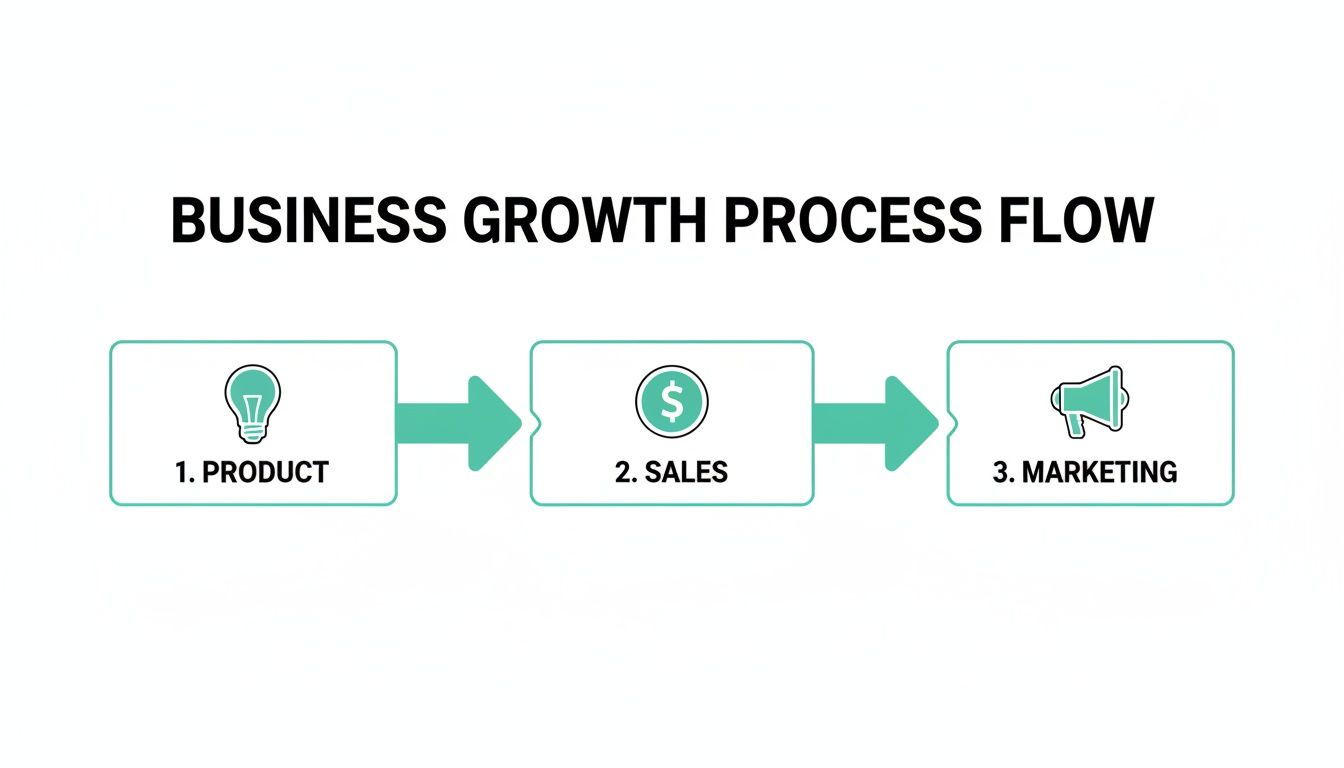
This process is a cycle. Listening informs product improvements, which then gives your sales and marketing teams fresh, compelling angles to work with.
Workflow Example: Competitor Opportunity Analysis
One of the sneakiest—and most powerful—ways to use social listening is to find openings by keeping a close eye on your competitors. This workflow is all about spotting their weaknesses and turning them into your strengths. We go deep on this tactic in our full social listening report.
The idea is to zero in on customer complaints, missing features, or marketing blunders that you can jump on. Here’s a simple way to set it up:
- Define Keywords: Start by tracking mentions of your top competitors. But don't just track their name—pair it with negative keywords like "frustrated," "broken," "slow," "can't," or "wish it had."
- Identify Pain Points: As the results come in, look for patterns. Are people constantly complaining about a specific feature? Is their support team nowhere to be found? These are your golden opportunities.
- Take Action: Once you find a clear pain point that your product solves beautifully, it's time to move. Your sales team can reach out to those unhappy users directly, or your marketing team can spin up a targeted ad campaign highlighting how you solve that exact problem.
By systematically tracking what your competitors are doing wrong, you’re basically creating a direct pipeline of warm leads and incredibly valuable market intel. You’re not just waiting for opportunities to show up; you're actively hunting them down.
Workflow Example: Proactive Customer Service
Another game-changing workflow is using social listening to find and solve customer issues before they blow up. A lot of people vent their frustrations online without ever bothering to tag a brand's official account. This workflow helps you find those untagged conversations and turn a bad experience into a great one.
- Keywords to Track: Monitor mentions of your brand and product names, especially the ones without the "@" symbol. Don't forget to track common misspellings of your brand, too.
- Insights to Look For: Filter for posts that have a negative tone or questions that show someone is confused or stuck. Keep an eye out for phrases like "how do I fix" or "is anyone else having trouble with."
- Immediate Actions: When you spot a customer in distress, jump in to help. Offer a solution, point them to a help doc, or connect them with a support agent. This kind of proactive support shows you're actually listening and you care, which can build some serious brand loyalty.
By putting structured workflows like these into place, social listening goes from a passive monitoring tool to an active, results-focused strategy. It gives your teams a clear playbook to follow, ensuring that insights consistently lead to real business wins.
Choosing the Right Social Listening Tools
Knowing the "why" behind social listening is one thing, but finding the right tech to actually do it is another. The best tool isn't the one with the flashiest dashboard—it's the one that aligns with your business goals and turns a sea of online chatter into data you can actually use.
The market for these platforms is exploding. It's estimated to be a $9 billion industry in 2024 and is on track to grow by another 16% in the next year as more companies and new AI features come online. You can read the full research on this market growth if you want to dig into the numbers.
This boom means you have a ton of options, so you need to know what to look for. Exploring some of the best social media monitoring tools is a good starting point to see what's out there.
Focusing on Strategic KPIs Not Vanity Metrics
A good social listening platform pulls you away from vanity metrics like likes and follower counts. Instead, it helps you track the Key Performance Indicators (KPIs) that actually show you’re making an impact on the business. These are the numbers that prove your work has a real ROI.
Here are a few key metrics to zero in on:
- Share of Voice (SOV): This is your brand’s slice of the conversation compared to your competitors. If your SOV is climbing, you know your marketing and brand-building efforts are hitting the mark.
- Net Sentiment Score: This goes way beyond just positive versus negative mentions. It calculates the overall mood of the conversations surrounding your brand, giving you a clear benchmark for brand health.
- Lead Generation Influence: The best tools connect the dots between social insights and sales. They help you track how many high-intent leads you’ve found and converted directly from your listening efforts.
The right tool doesn't just show you data; it provides a framework for interpreting that data. It helps you answer critical questions like, "How are our new messaging campaigns affecting public perception?" or "Which competitor weakness is generating the most customer complaints we can act on?"
Essential Features to Look For
When you start comparing platforms, focus on the features that will deliver real strategic value. For a deeper dive into specific options, check out our guide on the best social listening tools on the market right now.
Make sure any tool you consider has:
- AI-Powered Sentiment Analysis: The tech needs to be smart enough to understand nuance, like sarcasm or industry-specific slang, to give you an accurate read on how people really feel.
- Predictive Trend Identification: Modern tools can spot conversations and trends before they go mainstream, giving you a head start on creating relevant content or campaigns.
- Customizable Dashboards and Alerts: You should be able to build a dashboard that shows only your most important KPIs and set up real-time alerts for critical events, like a sudden spike in negative comments.
Choosing a platform with these features means you’re getting more than just a data feed. You’re getting a strategic partner that helps your marketing, sales, and product teams make smarter decisions.
Common Social Listening Mistakes to Avoid
Even the most powerful social listening setup can fall flat if you're not careful. The tech is impressive, sure, but its real power comes from how you wield it. Steering clear of a few common pitfalls is the key to making sure your program delivers real value, not just a bunch of noise.
One of the biggest mistakes people make is focusing too narrowly on their own brand. If all you're doing is tracking direct mentions of your company name, that's just social monitoring. Real listening means zooming out to understand the bigger conversations happening across your entire industry—including what people are saying about your competitors and the problems your customers are trying to solve.
Another classic trip-up is taking sentiment analysis at face value. Automated tools are fantastic, but they can easily get tripped up by sarcasm, irony, or cultural inside jokes.
Suffering From Analysis Paralysis
It's shockingly easy to get buried in data. A lot of businesses fall into the trap of collecting mountains of information but never actually doing anything with it. We call this "analysis paralysis," where the firehose of data leads to doing nothing instead of making smart decisions.
The best way to sidestep this is to lead with questions. Don't just gather data for the sake of it. Instead, build your dashboards and searches around specific business goals.
- Instead of just tracking mentions, ask, "What are the top three frustrations customers have with our competitor's onboarding?"
- Don't settle for generic sentiment scores. Ask, "How has sentiment around our new feature changed in the last 30 days?"
- Look past the volume. Ask, "Which new industry trend is getting the most buzz among our ideal customers?"
The point of social listening isn't to create the world's biggest spreadsheet of mentions. It's to find the specific, actionable nuggets of insight that help you make better decisions, faster. If your data isn't pointing you toward a clear next step, you’re not really listening.
When you tie every listening effort back to a real business question, you keep your program sharp and impactful from day one. This focused approach is what turns a stream of data into a strategic asset that actually drives growth.
Frequently Asked Questions
Even with the best strategy, some practical questions always pop up when you're just getting started. Here are a few of the most common ones we hear.
Can Social Listening Be Used for B2B Companies?
You bet. While everyone talks about social listening in the context of consumer brands, it's incredibly powerful for B2B.
Instead of tracking broad brand sentiment, a B2B company might track conversations around specific software needs or industry regulations their product solves. You can monitor industry trends, see what competitors are launching, and even find key decision-makers talking about their biggest pain points on platforms like LinkedIn and X.
How Much Does a Social Listening Tool Typically Cost?
The investment can vary quite a bit. You can find some entry-level tools for small businesses that start around $100 per month.
On the other end, enterprise-grade platforms with deep AI analytics and massive data sources can run several thousand dollars a month. The right fit really depends on what you need, like how many keywords you plan to track and how deep you need the analytics to go.
It's worth remembering that the best results come over time. While you can find quick wins and immediate insights, the real value of social listening emerges from consistent analysis and action over several months. That's how you measurably improve brand reputation and influence product strategy.
Ready to turn online conversations into actionable leads? Intently uses AI to find high-intent customers discussing your product, competitors, and industry right now. Stop guessing and start growing at https://intently.ai.